
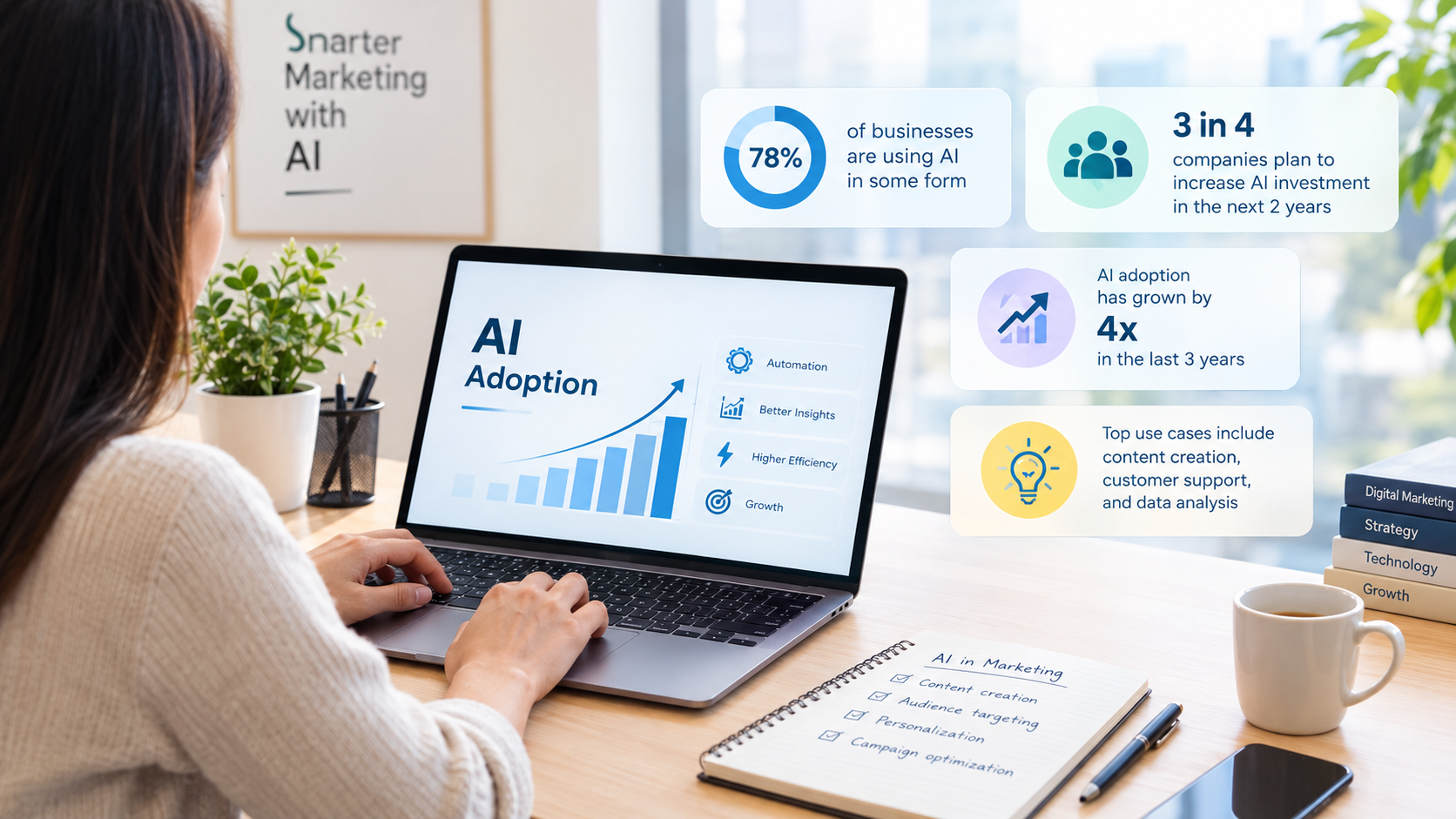
Artificial intelligence (AI) has moved from being an emerging technology to becoming an important part of how businesses operate, make decisions, serve customers and develop products. In 2026, organizations across industries are investing in AI adoption, generative AI, AI-powered automation and machine learning to improve efficiency and create new business opportunities.
From AI-powered customer service and marketing to software development, cybersecurity and data analytics, the use of AI is expanding rapidly. Understanding the latest AI adoption statistics for 2026 can help businesses identify emerging opportunities, benchmark their AI maturity and understand where the technology is heading.
In this article, we explore the latest AI adoption statistics, trends and insights shaping businesses and industries in 2026.
Key AI Adoption Statistics 2026
Here are some of the major trends businesses should know about AI adoption in 2026:
- AI adoption continues to expand across businesses of different sizes and industries.
- Generative AI has become one of the fastest-growing applications of artificial intelligence.
- Organizations are increasingly integrating AI into existing business workflows rather than treating it as a standalone technology.
- AI is being used for content creation, customer service, software development, marketing, analytics, cybersecurity and automation.
- Businesses are increasingly focused on measuring the return on investment (ROI) from AI initiatives.
- AI adoption is shifting from experimentation toward production-level implementation.
- Employees are increasingly using AI assistants and generative AI tools to support everyday tasks.
- Companies are investing in AI governance, security, privacy and responsible AI practices alongside adoption.
Note: AI adoption statistics can vary depending on the survey methodology, geographic market, company size and definition of “AI adoption.” Statistics should therefore be interpreted in context.
What Is AI Adoption?
AI adoption refers to the process of implementing artificial intelligence technologies within an organization, business process or product.
AI adoption can include technologies such as:
- Machine learning
- Generative AI
- Large language models (LLMs)
- Natural language processing
- Computer vision
- Predictive analytics
- AI-powered automation
- AI assistants and chatbots
- Recommendation systems
AI adoption does not necessarily mean that a company has completely automated a business function. In many cases, organizations use AI to augment employees, automate repetitive activities or provide better insights for decision-making.
AI Adoption Statistics by Business
Businesses are increasingly moving beyond AI experimentation and incorporating AI into operational workflows.
Organizations are using AI for a wide range of business functions, including:
1. Marketing and Content
AI tools are helping marketing teams with:
- Content generation
- Keyword research
- Personalization
- Customer segmentation
- Campaign analysis
- Ad copy creation
- SEO research
- Email marketing
Generative AI has made it easier for marketing teams to produce and customize content at scale.
2. Customer Service
AI-powered chatbots and virtual assistants are becoming increasingly common in customer support.
Businesses can use AI to:
- Answer frequently asked questions
- Provide 24/7 support
- Route customer requests
- Summarize customer conversations
- Assist human agents
- Analyze customer sentiment
This makes customer service one of the important areas for AI adoption in business.
3. Software Development
AI is also changing how software is developed. Developers can use AI coding assistants to generate code, explain existing code, identify bugs, write tests and accelerate documentation.
As AI coding tools become more capable, software development is expected to remain one of the major areas of enterprise AI adoption.
4. Data Analytics
Organizations generate huge volumes of data every day. AI can help businesses analyze this information and identify patterns that may be difficult to detect manually.
Common applications include:
- Predictive analytics
- Demand forecasting
- Fraud detection
- Customer analytics
- Risk assessment
- Business intelligence
Generative AI Adoption Statistics 2026
Generative AI has become one of the most significant drivers of recent AI adoption.
Unlike traditional AI applications that are often designed for specific analytical or predictive tasks, generative AI can create new content such as text, images, code, audio and video.
Businesses are adopting generative AI for:
- Content creation
- Marketing
- Research
- Customer support
- Software development
- Document summarization
- Data analysis
- Internal knowledge management
- Product development
The growing accessibility of generative AI has also reduced the barrier to experimentation. Employees can interact with AI tools using natural language without requiring advanced technical skills.
However, widespread experimentation does not automatically mean successful enterprise adoption. Organizations still need to address data privacy, accuracy, security, intellectual property, governance and employee training.
AI Adoption by Industry
AI adoption is not limited to technology companies. Organizations across multiple sectors are exploring AI applications.
Healthcare
Healthcare organizations are exploring AI for:
- Medical research
- Clinical documentation
- Diagnostic support
- Drug discovery
- Patient communication
- Administrative automation
AI can potentially reduce administrative workloads while helping healthcare professionals process large amounts of information.
Financial Services
Banks, financial institutions and fintech companies are using AI for:
- Fraud detection
- Risk analysis
- Customer service
- Credit assessment
- Financial forecasting
- Personalized recommendations
- Compliance monitoring
Because financial organizations handle large volumes of data, AI can play an important role in improving operational efficiency and identifying unusual patterns.
Retail and E-commerce
Retailers are using AI to improve both customer experience and operations.
Common applications include:
- Product recommendations
- Personalized shopping experiences
- Demand forecasting
- Inventory management
- Customer support
- Dynamic pricing
- Marketing automation
AI-powered recommendations can help businesses understand customer preferences and deliver more relevant products.
Manufacturing
Manufacturers are adopting AI for:
- Predictive maintenance
- Quality control
- Supply chain optimization
- Production planning
- Robotics
- Demand forecasting
AI can help manufacturers identify potential equipment failures and optimize production processes.
Education
AI adoption in education includes:
- Personalized learning
- AI tutoring
- Content creation
- Automated assessments
- Administrative support
- Research assistance
Educational institutions are also developing policies around the responsible use of generative AI by students and educators.
Why Are Businesses Adopting AI?
Several factors are contributing to the growth of AI adoption.
1. Increased Productivity
AI can automate repetitive tasks and help employees complete certain activities faster.
For example, employees can use AI to summarize documents, analyze information, generate first drafts and organize data.
2. Cost Optimization
Automation can help businesses reduce the amount of time spent on repetitive processes. However, the financial impact depends on implementation costs, workforce requirements and how effectively AI is integrated into existing workflows.
3. Better Customer Experience
AI allows businesses to provide personalized interactions and faster responses.
AI-powered recommendations, chatbots and virtual assistants can help organizations deliver more relevant experiences.
4. Faster Decision-Making
AI can process large amounts of information and identify patterns quickly. This can support data-driven decision-making across areas such as sales, marketing, finance and operations.
5. Competitive Advantage
Businesses that successfully integrate AI into their products and processes may gain advantages in productivity, customer experience and innovation.
Enterprise AI Adoption vs. Consumer AI Adoption
AI adoption can broadly be divided into two categories: enterprise AI adoption and consumer AI adoption.
Enterprise AI Adoption
Enterprise adoption refers to organizations using AI across business functions.
Examples include:
- AI-powered customer service
- AI analytics
- AI software development
- Marketing automation
- Predictive models
- Internal AI assistants
Enterprise adoption typically requires greater focus on data security, governance, integration and compliance.
Consumer AI Adoption
Consumer AI adoption refers to individuals using AI applications for personal or everyday activities.
Popular use cases include:
- Writing assistance
- Image generation
- Search and research
- Education
- Personal productivity
- Translation
- Travel planning
- Entertainment
The growth of consumer AI usage is also influencing workplace adoption as employees become familiar with AI tools independently.
AI Adoption Challenges in 2026
Despite rapid adoption, businesses still face several challenges when implementing AI.
Data Privacy and Security
AI systems may process sensitive business or customer information. Organizations therefore need clear policies around what data can be shared with AI systems.
Accuracy and Hallucinations
Generative AI can sometimes produce incorrect or misleading information. Businesses need human oversight and appropriate verification processes for important use cases.
Lack of AI Skills
Organizations may struggle to find employees with the technical and strategic skills required to implement AI successfully.
Integration With Existing Systems
Implementing AI is often more complex than simply purchasing an AI tool. Businesses may need to integrate AI with existing software, databases and workflows.
Measuring ROI
Organizations need to determine whether an AI initiative is producing measurable business value.
Important metrics may include:
- Time saved
- Cost reduction
- Revenue growth
- Conversion rate
- Customer satisfaction
- Employee productivity
- Error reduction
AI Adoption Trends to Watch in 2026
1. AI Agents
AI agents are becoming an important area of development. Instead of simply responding to prompts, AI agents can potentially perform multiple steps to complete a task.
Businesses are exploring agentic AI for research, customer support, workflow automation and software development.
2. AI-Powered Search
AI is changing how people search for information. Search experiences increasingly provide conversational answers, summaries and recommendations.
This creates new opportunities for businesses to optimize their content for both traditional search engines and AI-driven discovery.
3. AI in the Workplace
AI assistants are becoming part of everyday employee workflows. Businesses are increasingly exploring how AI can support knowledge workers rather than simply replace individual tasks.
4. Responsible AI
As adoption increases, organizations are placing greater emphasis on:
- AI governance
- Data privacy
- Security
- Transparency
- Human oversight
- Responsible AI policies
5. AI-Powered Personalization
Businesses are increasingly using AI to personalize customer experiences based on behavior, preferences and historical interactions.
The Future of AI Adoption
AI adoption is likely to continue expanding as technology becomes more accessible and organizations gain greater experience implementing AI.
The next stage of AI adoption will likely focus less on simply asking whether a company uses AI and more on how effectively AI is integrated into business processes.
Successful organizations will need to combine technology with:
- High-quality data
- Skilled employees
- Strong governance
- Clear business objectives
- Appropriate security measures
- Continuous measurement
- Human oversight
AI adoption should therefore be viewed as an ongoing business transformation rather than a one-time technology investment.
Frequently Asked Questions About AI Adoption Statistics 2026
What is the AI adoption rate in 2026?
The AI adoption rate varies significantly depending on the survey, country, organization size and definition of AI adoption. Businesses may report anything from experimentation with AI tools to full-scale deployment across multiple business functions, so individual statistics should be evaluated based on their methodology.
How many companies are using AI in 2026?
A growing number of companies are experimenting with or deploying AI. Adoption is particularly strong in areas such as generative AI, customer service, marketing, analytics and software development.
What is the most commonly used AI technology in 2026?
Generative AI and large language model-based applications are among the most visible AI technologies in 2026. Businesses are also widely using machine learning, predictive analytics, recommendation systems and AI-powered automation.
Which industry has the highest AI adoption?
AI adoption varies by region and measurement method. Technology, financial services, professional services, retail, healthcare and manufacturing are among the industries making significant investments in AI.
Why is AI adoption increasing?
The major drivers include productivity improvements, automation, cost optimization, better customer experiences, faster data analysis and the growing accessibility of generative AI tools.
What are the biggest challenges to AI adoption?
Common challenges include data privacy, cybersecurity, implementation costs, lack of AI skills, integration with existing systems, regulatory requirements and concerns about AI accuracy.
Conclusion
The AI adoption statistics for 2026 highlight a broader shift in how organizations approach artificial intelligence. AI is no longer limited to research laboratories or highly technical teams. Businesses across industries are increasingly using AI for productivity, automation, customer experience, analytics and innovation.
Generative AI is accelerating this transformation by making advanced AI capabilities accessible to a much broader audience. At the same time, organizations need to balance adoption with responsible implementation, data security, governance and human oversight.
For businesses, the key question in 2026 is no longer simply “Are we using AI?” but “Where can AI create measurable and sustainable business value?”
Organizations that can answer this question and integrate AI strategically into their workflows will be better positioned to benefit from the next phase of AI-driven transformation.

Kartik Poduval
Co Founder at Lantern Digital