

From personalized product suggestions to targeted offers, e-commerce personalization is transforming how online brands connect with shoppers. Businesses that understand individual customer behavior are seeing stronger engagement, better conversions, and lasting loyalty.
What is E-commerce Personalization?
In the intricate world of online retail, e-commerce personalization is the art and science of leveraging data insights to deliver a customized and relevant experience to each user. Imagine a scenario where a customer, upon logging into an e-commerce site, is greeted with product recommendations perfectly aligned with their past purchases, geographical location or browsing history. This level of customization fosters a sense of connection and understanding, elevating the overall shopping experience.
Business Bot believes that the best e-commerce personalization goes beyond simply addressing the customer by their name; it’s about anticipating their needs and preferences before they even express them.
According to Statista, 44% of consumers are likely to become repeat buyers after a personalized shopping experience.
E-commerce Personalization encompasses various strategies, including tailored product recommendations, personalized emails, and even customized landing pages. Let us discover all these in this blog.
Benefits of E-commerce Personalization
The E-commerce personalization includes some of the benefits as mentioned below:
1. Enhanced Customer Experience:
In the realm of tailored product recommendations and personalized shopping journeys, businesses witness a transformation in the online experience. By implementing customization in e-commerce, such as personalized content and offers, the journey becomes not just transactional but a truly enjoyable interaction for the customer.
Example: A fashion retailer employing AI algorithms to analyze a customer’s past purchases and browsing behavior, offering personalized recommendations for clothing and accessories. This not only streamlines the shopping process but enhances the overall satisfaction of the customer.
2. Increased Customer Engagement:
The integration of personalized emails and notifications elevates customer engagement by creating a direct and relevant channel of communication. Dynamic website content further contributes, ensuring that visitors are captivated and encouraged to extend their stay, fostering a continuous connection.
Example: An online electronics store sending personalized emails to customers based on their previous purchases, introducing them to new products or exclusive deals tailored to their preferences. This direct and relevant communication boosts engagement and encourages customers to stay connected with the brand.
3. Improved Conversion Rates:
Relevant product suggestions and personalized promotions play a pivotal role in driving higher conversion rates. When coupled with customized calls-to-action tailored to individual preferences, customers are prompted to make quicker decisions, enhancing the overall efficiency of the conversion process.
Example: An e-commerce platform providing personalized promotions during seasonal sales, aligning with individual customer preferences. This tailored approach not only captures the customer’s interest but also prompts quicker decision-making, leading to increased conversion rates.
4. Enhanced Brand Loyalty:
Creating personalized experiences goes beyond transactions; it establishes a profound connection that breeds brand loyalty. Recognizing and rewarding customer preferences becomes a trust-building exercise, fostering not just repeat business but a genuine affinity towards the brand.
Example: A beauty brand implementing a loyalty program that recognizes and rewards customers for their specific product preferences and purchase history. This personalized approach goes beyond transactions, fostering a genuine connection and loyalty to the brand.
5. Effective Upselling and Cross-selling:
The power of personalization algorithms is evident in identifying upselling opportunities for complementary products. During the checkout process, cross-selling suggestions strategically increase the average order value, showcasing the revenue-driving potential of personalized strategies.
Example: An online bookstore utilizing personalization algorithms to suggest complementary books based on a customer’s recent purchases. During the checkout process, strategically placed cross-selling suggestions for related genres or authors increase the average order value.
6. Optimized Marketing Strategies:
Targeted marketing campaigns, fueled by customer behavior data, yield a higher return on investment. Utilizing personalized ad content ensures relevance, capturing the audience’s attention and significantly increasing the effectiveness of marketing efforts.
Example: A subscription-based service, leveraging customer behavior data to send targeted marketing campaigns. By analyzing preferences and engagement patterns, the businesses can tailor its content, resulting in a higher return on investment and increased effectiveness of the marketing efforts.
7. Reduced Cart Abandonment:
Personalized reminders and offers act as a powerful tool in recovering abandoned carts. Addressing specific customer concerns through personalization not only reduces hesitation but also provides a proactive solution to potential obstacles in the purchase journey.
Example: An online grocery store implementing personalized reminders for customers who abandoned their shopping carts, including exclusive discounts on the items left behind. This not only recovers potential lost sales but also addresses specific concerns, reducing hesitation in the purchase journey.
8. Data-Driven Decision Making:
Analyzing personalized data provides invaluable insights for strategic decision-making. Real-time adjustments based on customer preferences enhance overall business strategies, creating a dynamic and responsive approach.
Example: A tech retailer analyzing personalized data to identify popular product categories and customer preferences. Real-time adjustments in inventory and marketing strategies based on this data enhance overall business strategies, ensuring a dynamic and responsive approach to market demands.
9. Competitive Advantage:
Implementing robust e-commerce personalization isn’t just a feature; it’s a competitive advantage. Offering a superior personalized experience sets your business apart, attracting and retaining customers in a market where personalization is increasingly becoming an expectation.
Example: A furniture store investing in advanced e-commerce personalization technology to provide a superior shopping experience. This sets the business apart in a crowded market, attracting and retaining customers who appreciate the tailored and personalized approach.
10. Measurable Performance Metrics:
Trackable data on personalized campaigns enables continuous improvement. Monitoring key performance indicators refines and optimizes personalization strategies, ensuring that the business is not just providing a personalized experience but also evolving with the changing landscape of customer preferences.
Example: An online marketplace tracking key performance indicators such as click-through rates, conversion rates, and customer satisfaction scores for personalized campaigns. This data-driven approach allows the business to continuously refine and optimize their personalization strategies for better results over time.
E-commerce Personalization Strategies
There are few of the personalization strategies that will help e-commerce businesses mentioned below:
1. User Behavior Analysis:
Understanding how users interact with your platform is key to personalization success. Utilize analytics tools to track user behavior, such as pages visited, time spent, and products viewed. By analyzing this data, you can create personalized product recommendations and targeted marketing campaigns.
Example: Amazon’s recommendation engine analyzes user browsing and purchase history to suggest products, resulting in a significant boost in sales.
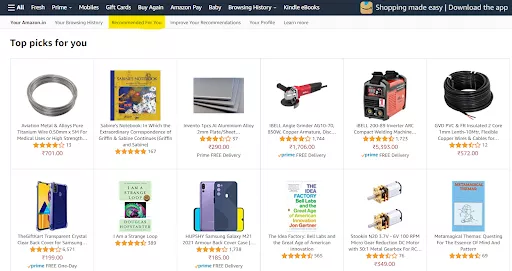
Statistic: According to a study by Accenture, 91% of consumers are more likely to shop with brands who provide relevant offers and recommendations.
2. Dynamic Content Customization:
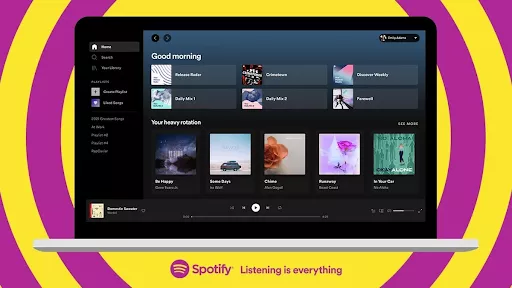
Dynamically adapting your website content based on user preferences enhances the overall shopping experience. Tailor product displays, banners, and promotional messages to align with individual interests and behaviors.
Example: Spotify curates personalized playlists based on user listening history and preferences, creating a unique experience for each user.
3. Personalized Email Campaigns:
Crafting personalized email campaigns can significantly impact customer engagement and conversion rates. Use customer data to send targeted emails featuring product recommendations, exclusive offers, and personalized content.
Example: Netflix sends personalized email recommendations based on the user’s watch history, increasing user retention and satisfaction.
Statistic: According to a study by Experian, personalized emails deliver 6x higher transaction rates compared to non-personalized ones.
4. AI-Powered Chatbots:
Implementing AI-driven chatbots on your e-commerce platform provides real-time assistance and recommendations to users. These chatbots can analyze user queries, preferences, and purchase history to offer tailored suggestions.
Statistic: Gartner predicts that by 2025, 95% of customer interactions will be powered by AI.
5. Segmented Marketing Campaigns:
Divide your customer base into segments based on demographics, behavior, or preferences. Tailor marketing campaigns for each segment, delivering content and promotions that resonate with specific audience segments.
Example: Nike creates targeted marketing campaigns for different customer segments, focusing on personalized messaging and product recommendations.
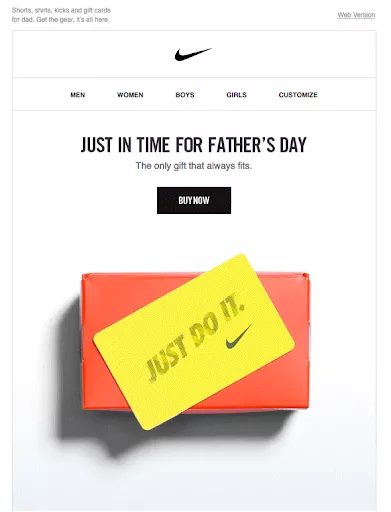
Statistic: According to a study by Mailchimp, segmented email campaigns result in a 14.31% higher open rate compared to non-segmented ones.
6. Personalized Product Recommendations:
Leverage machine learning algorithms to provide customers with personalized product recommendations based on their browsing and purchase history. Showcase these recommendations prominently on your website to encourage additional purchases.
Statistic: A study by Barilliance indicates that personalized product recommendations can account for up to 31% of e-commerce site revenues.
7. Geo-Targeted Offers:
Tailor promotions and offers based on the user’s location. Utilize geolocation data to provide personalized discounts, promotions, or even highlight products popular in the user’s region.
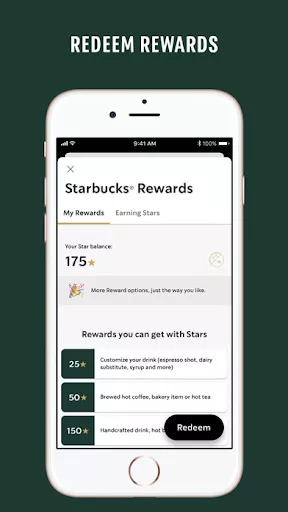
Example: Starbucks uses geotargeting to send personalized offers and promotions to customers based on their proximity to Starbucks locations.
Examples of Personalization in E-commerce
1. Amazon’s Personalized Product Recommendations
One of Amazon’s prominent personalization strategies is its sophisticated use of personalized recommendations. By leveraging user browsing and purchase history, Amazon tailors product suggestions to each individual customer. The platform’s recommendation engine analyzes the user’s past interactions, such as viewed products, previous purchases, and items added to the shopping cart, to generate personalized suggestions that align with the user’s preferences and interests.
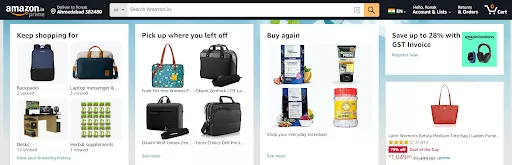
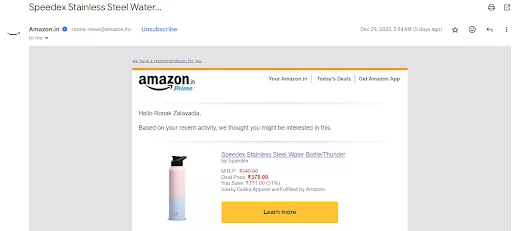
In addition to personalized product recommendations, Amazon excels in implementing targeted marketing emails. The company utilizes customer data to craft personalized email campaigns, featuring relevant product suggestions, exclusive offers, and promotions. These emails are designed to resonate with each user, creating a more engaging and tailored shopping experience.
By combining personalized recommendations on the platform with strategic email marketing, Amazon maximizes its ability to connect with customers on a personal level, enhancing customer satisfaction and driving increased sales.
A study by McKinsey & Company, Amazon’s personalized recommendation system increases the likelihood of customers making a purchase by 60%.
2. Netflix’s Personalized Content Recommendations
Netflix employs a sophisticated recommendation algorithm that analyzes users’ viewing history, preferences, and behavior to curate personalized content suggestions. By understanding individual tastes and viewing patterns, Netflix aims to enhance user engagement and satisfaction, making the streaming experience more tailored to each subscriber.
Netflix reports a significant increase in viewer satisfaction when utilizing personalized content recommendations. Users are more likely to find and enjoy content that aligns with their interests, leading to higher retention rates.

The implementation of personalized content recommendations has resulted in a substantial increase in overall watch time on the platform. Subscribers are inclined to spend more time exploring and watching content, contributing to the platform’s success.
Netflix takes personalization a step further by customizing user interfaces. This involves tailoring the layout, design, and presentation of content on the platform based on individual preferences and behavior. This strategy aims to create a seamless and enjoyable experience for each user, optimizing their interaction with the platform.
3. Personalized Playlists and Music Recommendations from Spotify
Spotify revolutionizes the music streaming experience by employing a sophisticated personalization strategy. Through the analysis of user preferences, listening history, and behavior, Spotify creates customized playlists and music recommendations tailored to each individual user.
Spotify’s commitment to personalization has yielded impressive results:
User Engagement: Users who regularly engage with personalized playlists are reported to spend more time on the platform, indicating a higher level of user satisfaction and retention.
Increased Listening Frequency: Studies show that users who receive personalized music recommendations are more likely to increase their listening frequency, leading to a deeper integration of Spotify into their daily lives.
Subscription Renewal Rates: Personalized content has been linked to higher subscription renewal rates, showcasing the impact of tailored music experiences on user commitment and loyalty.
4. Google’s Personalized Search Results and Advertisements
Google employs sophisticated algorithms to personalize search results and advertisements based on individual user behavior. By analyzing search history, location data, and online activity, Google tailors the search experience to provide users with highly relevant and personalized results. This not only enhances the user’s search experience but also enables advertisers to reach their target audience more effectively.
According to a study by Google, personalized ads are 40% more likely to be clicked on by users. Personalized search results lead to a 30% higher click-through rate compared to non-personalized results.
Google integrates personalized features like Google Assistant to elevate the overall user experience. Google Assistant learns from user interactions, preferences, and habits to provide personalized recommendations, assistance, and information. Whether it’s suggesting nearby restaurants, managing daily tasks, or offering tailored news updates, Google Assistant is designed to make users’ lives easier and more personalized.
5. Starbucks Personalized Promotional Strategies
Starbucks has mastered the art of personalized customer experiences through its mobile app, offering tailored promotions and rewards to its loyal customers. Starbucks utilizes customer data gathered through the app to create targeted promotions and rewards that resonate with individual preferences and behaviors. By analyzing past purchases, the app tailors exclusive offers, discounts, and bonus rewards, creating a sense of personal connection with each user.
Starbucks has been implementing a digital-first strategy to drive personalization, loyalty-building, and global expansion. The company has been focusing on improving its mobile app usage and rewards programs, implementing exclusive pickup lanes for mobile orders, and enhancing timing algorithms to provide precise wait-time estimates for online orders.
Starbucks has also been investing in its Starbucks Rewards program, updating its redemption tiers, and launching Starbucks Rewards Odyssey, which integrates NFTs with the loyalty program to create an interactive Web3.

Starbucks has been using data-driven decision-making and strategic marketing to personalize its customer experience, with more than 60% of all Starbucks orders being customized to the individual customer. The company has been using clean data to analyze which channels and marketing offers inspire consumers to make purchases and has been segmenting its customers to develop attribution rules and interactive dashboards to track key metrics. Starbucks has been using technology to deepen customer relationships and drive loyalty, with personalization being a critical factor for the company to consider as the economy points to more challenges ahead.
E-commerce personalization is no longer optional, it’s the new standard. Brands like Amazon, Netflix, and Starbucks have proven that understanding your customer drives loyalty, higher conversions, and long-term growth.
In a crowded digital marketplace, personalization is what sets you apart. Start leveraging your customer data today, and turn every interaction into an experience worth coming back for.

Kartik Poduval
Co Founder at Lantern Digital